
Mix Notes – Vol. 2: Seth Munson (FREE LIMITER PRESET)
Our Content Creator Tom sat down with Seth Munson, a Billboard #1 mastering engineer whose credits include Nickelback, Bring Me the Horizon and Teddy Swims to name a few. In Seth’s words, “that's the crazy part of mastering, it's so much volume.” Safe to say, Seth’s experience is deep and storied, and we were honoured to discuss his use of the Oxford Limiter, his “unconventional” approach to mastering, and why he believes his mastering philosophy is what keeps his clients coming back year after year.
Tom: It would be great to know, where are you using Sonnox in your mastering? Are there any examples of places where you're reaching for one of our products?
Seth: It's mainly that limiter.
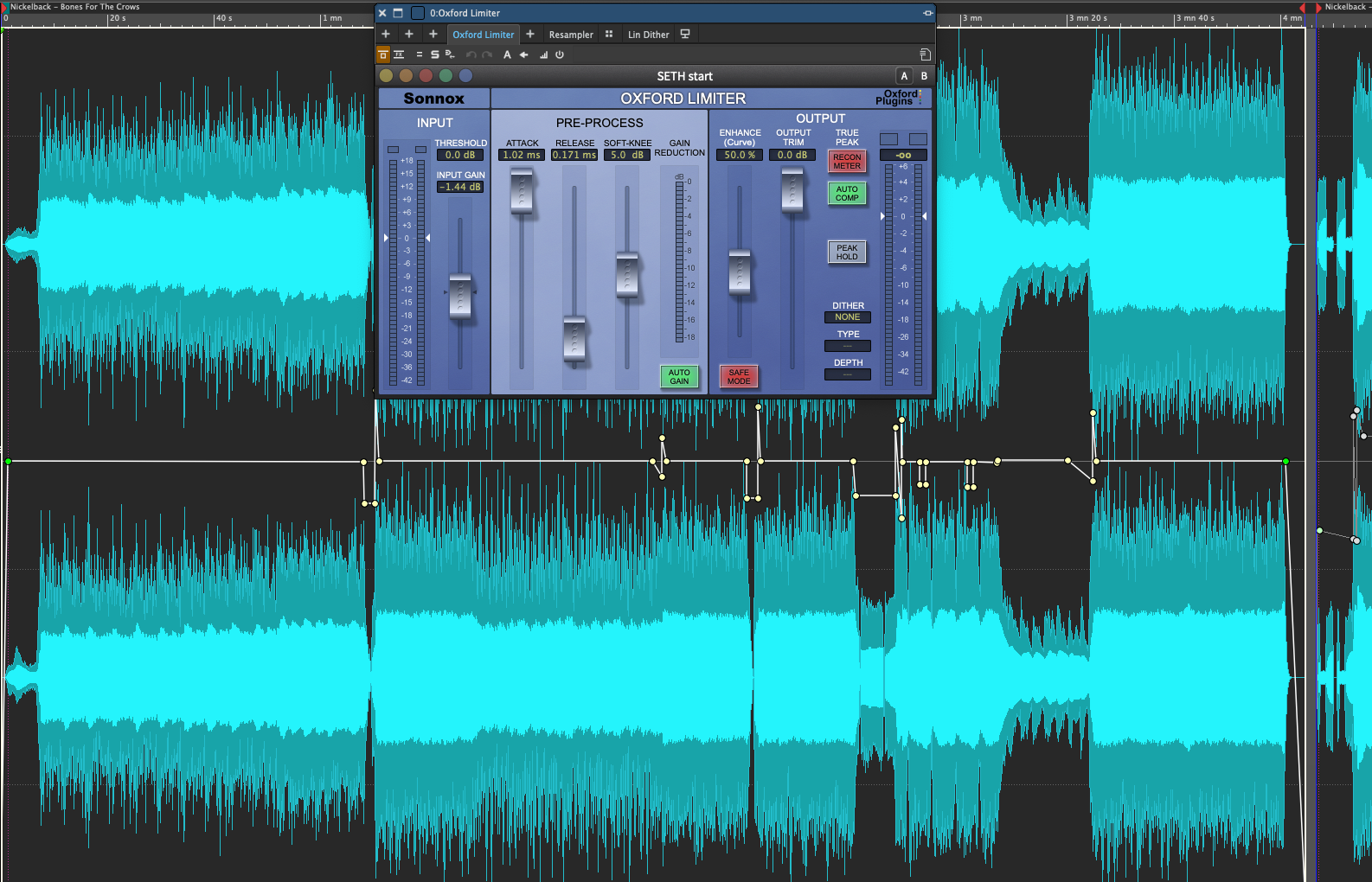
This is from the Nickelback single session. Like, that's just straight ripped from what I did this morning. I was like, oh, that's probably good to have.
Tom: It’s no surprise to me that as a mastering engineer, you're reaching for the Oxford Limiter. How do you approach the limiting stage of the mastering process? How do you get the sound out of it that you want?
Seth: It's funny because, like I said, my approach is different. And so you're like, “when you get to the limiting stage”, and I'm thinking “I start with the limiting stage. How hard can we push this master into the limiter”? And then I go backwards from there. So I might think “this feels like a good loudness, but it's breaking a little bit here or there”. And then I try to unbreak it. Like the low end is just a little too much and it's breaking the limiter. So, then I start to adjust and fix the low end. Often, I’ll shoot out a bunch of limiters with the source material right from the jump and see which one is working best on the source material.
Tom: So, am I right in thinking the first thing you do is push the input gain? Then, once you’re getting the sound and gain reduction you want, do you start adjusting the attack, release, and soft knee?
Seth: You're gonna hate this. I don't open the plugin! That’s what I love about the Oxford Limiter. When I was first getting hired for a bunch of Nashville stuff, I was sent these settings by Jonathan Roach, someone that I really liked and trusted, and he was like, “hey, this is what I've been using. This is what the artist approved.” So, I took those and I just made slight adjustments, and then I've just stuck with it.
I know it has a certain sound and when I know the record I’m mastering needs that sound, that’s when I reach for it. I don't adjust the input gain. I don't adjust the attack and release. I am pushing into those things with my automation and volume straight from the track itself. I know this sucks in the context of an interview…
Tom: Not at all! In a way you're saying you don’t need to be super involved when you're using the limiter, like you can push into it and get good results.
Seth: For sure. I know that when I need that sound, I trust how the parameters are set, and I like the flavour it brings. The knee being somewhat soft is part of the sound to me, right? If it was harder, it wouldn't breathe as much. That's part of the appeal of the Oxford Limiter is there's a room for the track to breathe a little more. It's not being so hard clipped, in a way. But when I need that, I know other limiters will do that fine. But I'm not looking for that when I reach for your limiter.
Tom: Are there specific genres where you're reaching for it?
Seth: Yeah. I find it works really well on organic genres – rock, country, stuff like that. I think it has to do with the general time domain of those genres. It has time between the low end information and energy to like reset. And again, that soft knee lets things through and allows the song to breathe a little bit.
Tom: I think that makes sense given Sonnox’s roots – when the technology was being developed and the music that was out at that time.
Seth: Yeah, agreed.
“I pulled up a Bring Me The Horizon song the other day and there were 1600 overs… I let the overs happen. If it sounds cool, it sounds cool. I do not care.”
Tom: Are you touching the output trim at all? I'm just thinking about overs.
Seth: Nope. I do have a limiter after this one that has the output trimmed down a little bit. But that one typically has no gain reduction on it. Because the Oxford Limiter before it is taking care of that. The limiter after it isn’t true peak, it's just like a safeguard for overs. But I don't care about overs either. I had a whole conversation with someone yesterday about this. He said, “I'm getting overs on my masters” and I was like, “okay, does it sound sweet?” And he said, “yeah, it sounds fine, but the numbers say this”. But for me, it’s like, who cares? Seriously, who cares?
I pulled up the overs on a Bring Me the Horizon song the other day and it said that there were 1600 overs, both in the right and left channels for this song. I let the overs happen. If it sounds cool, it sounds cool. I do not care.
Tom: I feel like some engineers want to believe that, but then aren't prepared to stand on business and actually be like, yeah, I can see red lights coming up, I can see overs, I can see a little bit of clipping going on. But I like it. Do you know what I mean? It's taste over everything.
Seth: Mhm. You need to know the rules in order to break them. And breaking the rules is what leads to progression.
Tom: Is there something you think is important for young or aspiring mastering engineers to understand early on in their career?
Seth: That's a good question. Let me see. I don't think it's healthy to chase arbitrary numbers or stats. A lot of people say, I aim for this loudness, right? I always do this. True peak or output or this trim, and there's just no rules for those things. Like, you'll probably be doing a disservice to the song if you're chasing things that aren't related to the song and you're trying to force things onto a master for the sake of meeting a certain metric or random number. That's the big thing and one of the things I hear most. In newer, younger engineers, is they’re putting limitations on themselves by trying to meet or not meet certain random numbers when it comes to like loudness, for example.
“A perfect master on paper sounds boring as hell to me.”
Tom: I don't know if you've seen those graphs of competence vs confidence.
Seth: The Dunning-Kruger effect.
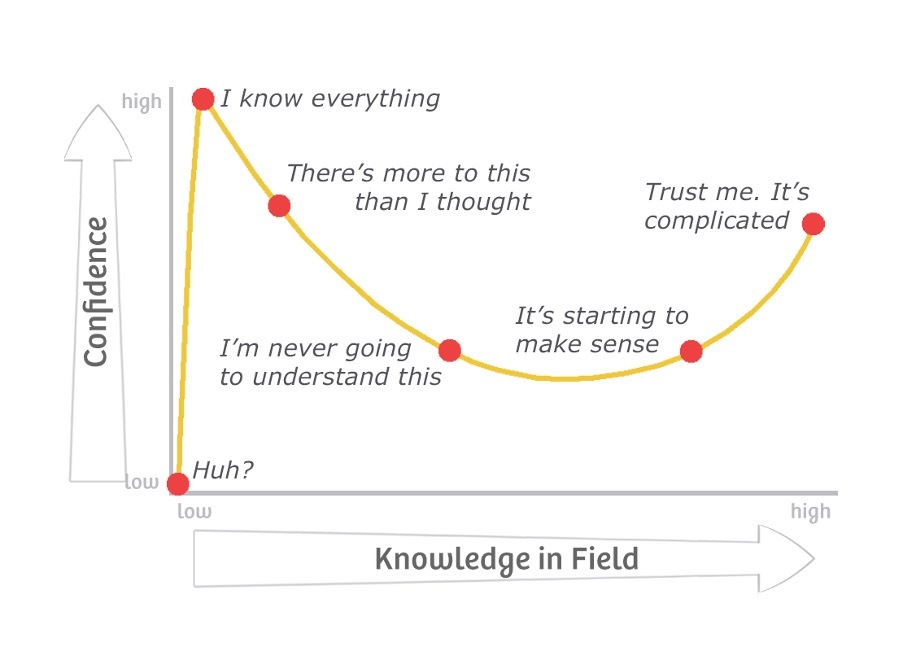
Tom: Exactly. You might be early on in your music journey and you don't have a lot of experience yet, but you have access to tonnes of information online. So, people develop these notions of what a process “should” be based on what they’ve researched. But the more experience you gather actually doing the thing, the question starts becoming “what does this song need – if anything”?
Seth: That last part you said is key. I did a master yesterday that consisted of a single limiter and some quality control. The artist loved it. But you're totally right on that. There are no hard, set rules, but a lot of people want there to be with mastering. But there just isn't.
Tom: It takes confidence to say “I've mastered this song using one limiter and I've not pushed it very hard. And I'm going to stand by my opinion that that's all it needs. I tried other things and it didn't work.”
Seth: Yeah, I'm not going to get in the way of this. It's an ego thing too, right? Like, I don't need to do something just for the sake of feeling like I had to do something.
Tom: And of course, there isn’t really such a thing as a perfect master. There's just masters you like and masters you don't like.
Seth: Yeah, well, a perfect master on paper sounds boring as hell to me.
Tom: Yeah. Like in the school of YouTube, you hear all the time, you need to deliver your masters to digital streaming platforms at -14 LUFS. But when I used to work at a recording studio, there was this very prestigious mix engineer who would send us his stereo masters for upmix into Dolby Atmos, and they were always like -4 LUFS. He just didn't care. And they sounded great!
Seth: Yeah, no, I would be fired if I was sending stuff out at -14 LUFS, that's for sure.
Tom: Really? That's interesting.
Seth: Most of the time, mixes are coming in at -7, -8 LUFS. I would have turn them down so much to beat that. I think that was just lost in translation when Spotify released that press release many years ago about delivery standards and I think people misread it.
They were just saying this is what we normalise to after mastering. And then people took that as, oh, well then I should master to that. But that's not what they said. They were saying this is a happy medium of where we like to pull things down after mastering.
Tom: Yeah, I feel like the internet just took that and ran with it. If you deliver something to Spotify at -4 LUFS, they might turn it down a couple dB, but the end user would never know that because it sounds as loud as everything else. Obviously if you deliver something lower than -14 LUFS, then Spotify might bring it up…
Seth: That scared me for a while. Because I'm a mastering engineer, I send that shit loud. So I've never done that, but in my mind, I was thinking, okay, if I send it too loud, they're going to turn it down. That's not the end of the world. But if I send it too quiet, what are they going to do to bring it up? And that scared me more than them turning it down. Because I don't know what that process looks like and it's out of my control.
Tom: Have you always been a mastering engineer or did you transition into it?
Seth: My whole career has been following where the industry wants me, basically. I started as a producer and songwriter. But then I started getting hired for mixes more than I was for productions. So I did that for a decade. And then I started getting hired more for masters than I was for mixes. I never set out to be a mastering engineer. It kind of just happened.
Tom: Being a producer requires a completely different skillset to mastering. But there's a lot of transferrable skills there too. Have the different experiences you’ve gathered across your career helped you become a better mastering engineer?
Seth: By a long shot. A lot of my mastering friends are very technical. They could tell you the ins and outs of every piece of hardware, or whatever. But I'm super song-focussed, because I come from a more musical perspective. I think that helps me stand apart from my peers.
Tom: Do you think understanding the intentions behind the music helps inform, or even influence mastering decisions?
Seth: For sure. I mean, if it's a sad song, I'm not going to make it super bright and happy sounding, right? I'm going to try to play into the emotion of the song. But of course, there’s technical aspects, too. Maybe I’m focused on vocal intelligibility, making sure B's don't sound like P's, or G's don't sound like K's, right? I’m always thinking about how the song can be best presented to the world.
Tom: So a good understanding of the art can actually inform the technical decision making. Could you elaborate?
Seth: Yeah. These aren't conscious decisions most of the time. I let the song tell me what needs to happen. Of course, there's technical aspects to it, but I try not to let those get in the way of my actual job, which is presenting the song and the artist’s message to the world. Not just imprinting my sound onto because I think that's how it should be. It's always song focussed.
Tom: Interesting. Obviously, you've got file delivery standards for DSPs and whatnot, but it sounds like that stuff comes after you've served the intentions of the song.
Seth: I always do native resolution and bit depth on first review because all the extra deliverables, technical stuff, QC – they’re pointless if the team doesn't like how it's sounding. That all comes after approval.
Tom: So, you think there's still room for creativity in mastering?
Seth: Oh, for sure. I mean, that's all it is – it's taste, right? People are hiring me for my taste, how I prefer things to sound. There's a whole technical aspect to it as well, but that doesn't have anything to do with my taste. I could hand that off to someone else and the delivery outcome wouldn't be any different.
Tom: It feels like there's a push and pull dynamic there. Have there been times where you're wrestling with a sonic direction you personally think is the right direction, versus what the artist wants out of a master?
Seth: Yeah. As much as I try to be invisible in the mastering process, I will have a sound. Everyone's experience of sound is unique, right? So how sound travels into my brain is going to be different to yours.
If I feel like I'm going a little heavy-handed on the processing, I’ll send an alternative version alongside my version, one where I’m barely making any moves. So, I'm always trying to let the artist decide. I know I have a different approach to mastering than most people. But I think that's part of the reason why I get hired.
Tom: What do you think is a “traditional” approach to mastering? What do you think is missing in that approach?
Seth: I don't know if I would say it's missing anything. I think it's... misguided. I feel like the more experienced mastering engineers have this approach. It's the newer generation – the self-mastered artists and producers who are brought up on YouTube and forums – that approach things differently. They have this perception of what mastering is – you apply this process into this process into this process, and now it's mastered. I don't view it that way.
I think that's the big surprise when a new artist comes to me and they go, well, you're doing things different. Like, this is not how they’ve had mastering experiences in the past. But those artists stick with me. They're not jumping mastering engineers every project. They understand that I'm here for them and that I'm here to help serve their message. And I think that resonates with them.
Tom: Agreed. I wanted to ask you about automation. Do you use automation when you’re mastering?
Seth: I spend more time automating than I do anything else. It's a constant thing. I'll give you a couple good examples. The main one is what I like to call push and pulling into the limiters. I’ll maybe pull back half a dB on a pre-chorus and have a gradual, slow ramp down. And then when that chorus hits, I bump it up half a dB. It's all a feeling thing. How does this feel going in to the limiter? Oh, I don't feel the impact as much. So I'll drive it a little bit harder and push it a little bit further. Then there’s micro dynamics. I’ll automate up +1dB for a burst of energy, maybe just for the length of the first kick drum of a downbeat. And when it hits, it just explodes and it feels great.
Another example of automation is I love de-essers on masters. And I feel like it’s a good way to create chorus energy. Instead of just making a chorus brighter, it's actually clamping down a little bit harder on verses and pre-choruses on the de-esser. And I will automate it down just a little bit more so the top end is just a little bit softer. So then once that chorus comes, I can open it up and it feels more exciting without having to add brightness. It's the natural organic brightness of the mix – but it feels more exciting. It feels bigger because the contrast from the verse and pre and the parts before and after are clamped down just a little bit harder because of a de-esser.
Tom: I have one more question. How would you describe your mastering philosophy? We're talking really big picture here.
Seth: There's a large layer of trust in the process that doesn't get talked about enough. It's a trusted friend, an ally who helps you see it over the finish line after all those hours spent on the creation side of things. Like, you're not going to get mixing advice from someone whose mixes you don't like. It’s the same thing with mastering. To me, that's the big picture. It's a big trust thing.
Tom: Nice. Well, that's brilliant – thanks for chatting with me today. Have a great rest of your day and enjoy your mastering.
Seth: Thank you, thank you, will do. Later.
Free Seth Munson Oxford Limiter Preset
Download the exact Oxford Limiter preset Seth Munson used on Nickelback’s “Bones for the Crows”, ready to load into your own sessions and tailor to your mix.
How to Install Seth's Oxford Limiter preset:
- Download the preset
- Open the Oxford Limiter in your DAW, click on the Preset Toolbar and click "Show in Finder"
- Drag the preset into the folder
- You can now find the preset in the Preset Toolbar